Mga Kwentong Tagalog
EG Hizon
The Tagalog comprise one of the eight major Philippine ethnolinguistic groups. “Tagalog” is believed to be a contraction of either taga-ilog or taga-alog, which is from the prefix taga, signifying place of birth or residence, and ilog, meaning river, or alog which is old Tagalog for the shallow portion of a river or a low-lying area that floods during rains. Thus the word means “river dwellers,” a direct reference to the riparian civilization of this group.
The prehistoric Austronesian Tagalog journeyed in outrigger boats called barangay or barangay to the archipelago after the last glacial period, from 5,000 BCE to 400 CE. They settled around the Manila Bay and gradually populated the Pasig River territory. From there, they steadily expanded and occupied the river valleys of Laguna de Bay. Another group may have landed in the Batangas region, spreading west and south toward the Bondoc Peninsula, and north toward Quezon.
Tagalog is the first language of most Filipinos and is spoken by more than 50 million in the Philippines. Tagalog has a reach that stretches far beyond its country of origin. It is the third most spoken non-English language in the United States, and its usage is growing in other parts of the world.
Tagalog began appearing in written form as far back as 900 CE. The oldest Filipino document found in the Philippines, the Laguna Copperplate Inscription, was written in Tagalog. It was discovered in 1989. In the beginning of the 18th century, Pablo Cain wrote the first Tagalog dictionary.
President Manuel L. Quezón proclaimed Tagalog as Wikang Pambansa in 1939 in a bid to unify the country. The language was renamed Pilipino in 1959 with Tagalog as the base of a national language that would incorporate words from other provincial dialects. The 1973 Constitution declared Pilipino to be co-official, along with English, and mandated the development of a national language, to be known as Filipino. it was expanded to 28 letters to include the entrie english alahbet, the spanish ñ, and tagalog ng.
For all intents and purposes, Pilipino and Filipino are indistinguishable from vernacular Tagalog, and are one and the same grammatically.
“Sa liwanag ng katotohanan at katapatang ipinababatid ng ating wika, tumitingkad ang ating pagkakaisa, lumalakas ang ating tinig at pagkakapit-bisig tungo sa pag-abot ng ating mga mithiin.” — Former President Benigno Aquino
The nature of the language
Tagalog is considered an “agglutinative language” (glued together) because many words are formed through the combination of small morphemes (the smallest meaningful component of linguistic expression). Examples of agglutinative languages include German, Turkish, Finnish, Hungarian, and Korean.
Tagalog is an Austronesian language, which makes it related to languages like Indonesian (Bahasa-Indones), Malaysian (Bahasa-Malay), Polynesian languages (such as Hawaiian) and even aboriginal Taiwanese. Tagalog has a plethora of loan words, particularly from Spanish and English, due to the long history of Spanish and American colonization of the Philippines. Like any modern language, Tagalog is a living tapestry of history and culture, shaped by the lives of tens of millions of people who speak it.
Tagalog verbs are morphologically complex and take on a variety of affixes to indicate focus, tense, aspect, and mood. Verbal affixes consist of a variety of prefixes, suffixes, infixes, and circumfixes.
An interesting feature of Tagalog verbs, as in other in Malayo-Polynesian languages, is its focus (or trigger) system. This means that the role of the noun is reflected in the verb by way of its affix. Some commonly recognized triggers are: actor, object, location, beneficiary, instrument, and reason.
Tagalog history
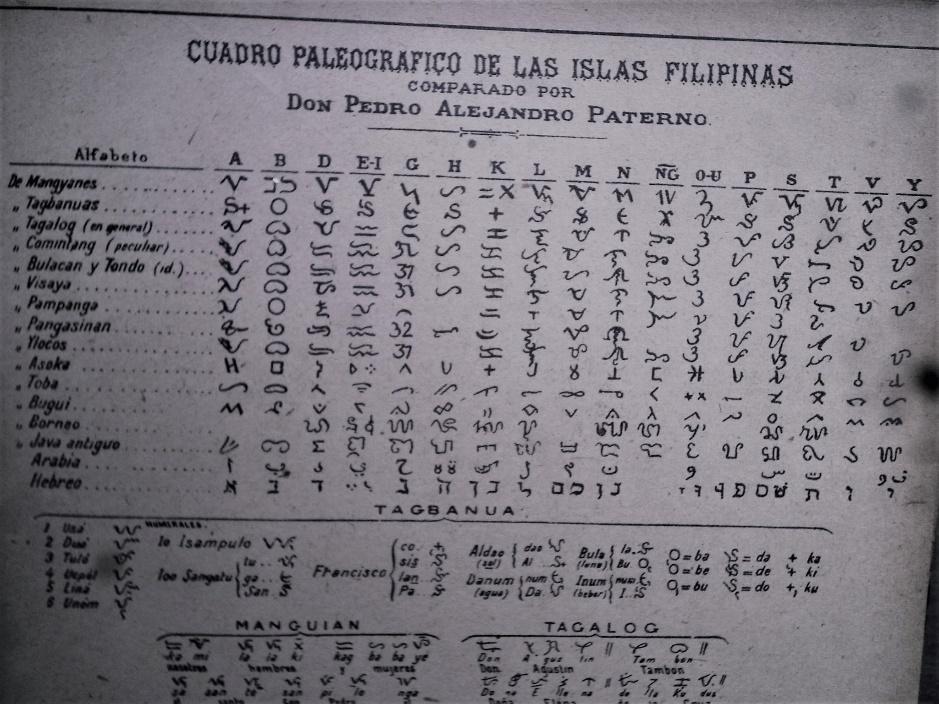
Ang Doctrina Cristiana (Doktrinang Kristiyano) ang pinakaunang aklat na naisulat sa Tagalog, na inakda noong 1593. Nakasulat ito sa Kastila at dalawang uri ng Tagalog: una sa Baybayin at sa mga titik ng Latin naman ang isa.
Wala pang nailathalang aklat na nagsasabi kung gaano katanda ang wikang Tagalog, subalit may dokumento na nagpapatunay na ang isang matandang uri ng wikang pinagmulan ng wikang Tagalog ay ginagamit na mahigit sa isang libong taon nang nakalipas. Ito ang limbag sa Tanso ng Laguna ng taong 822 A.D., isang bagay na patuloy pang inuusisa at pinag-aaralan ng mga nagdalubhasa sa wika.
Lope K. Santos, a Filipino grammarian, writer, and senator introduced the Abakada alphabet, adapted from the Latin alphabet. It consisted of 20 letters and was officially adopted in 1940 to be used for the new national language. He published the Balarila ng Wikang Pambansa (Grammar of the National Language), the first local grammar book.
The Philippine script called Baybayin is being revived by millennials today.
the reform movement led by jose rizal and marcelo h. del pilar published the diariong tagalog, which first came out in 1882, to expose friar and military abuses and to persuade the spanish government to grant reforms.
Tagalog folk literature:
Tagalog poetry has its origins in the centuries-old oral tradition, which produced folk speech, specifically the riddles, proverbs, and maxims, which either date to the precolonial period or were created in response to changing circumstances from the 16th century to the present.
Bugtong or Tagalog riddles:
may isang bayabas / na pito ang butas. (mukha)
(a guava fruit / with seven holes. [face])bumbong kung liwanag / kung gabi ay dagat. (banig)
(bamboo tube by day / a sea by night. [mat])
Kasabihan or Tagalog proverbs
ang hindi maronong lumingon sa pinanggalingan ay hindi makararating sa paroroonan.
paa na ang madulas / dila lamang ang huwag.
(better a slip of the foot / than a slip of the tongue.)
pag-aasawa’y di biro / kanin bagang isusubo / iluluwa pag napaso.
(marriage is no joke / like rice spat out / when too hot for the mouth.)
Tanaga or Tagalog maxims:
ang tubig may malalim / malilirip kung libdin / itong budhing magaling
maliwag paghanapin.
(no matter how deep the water / it can be fathomed / it is a good person
that is difficult to find.)
Tagalog traditions
Among the bulaqueños, the traditional disposoryo is held, in which the suitor, with his relatives and friends, parade into the beloved’s house, carrying the picture of the marriage of mary and and the vats of food and cases of drink for the wedding celebration.
In batangas, the husband races with the wife to the church door in the belief that whoever reaches it first will dominate the marriage.
In tayabas, a ballad called matrimonyo is sung during wedding ceremonies. called papuri in quezon and balayang in batangas, the ballad enumerates the duties of husbands and wives, explains the meaning of various marriage rites, and describes the nature of love and courtship.
Tinatawag na mananagalog o mananalita ang isang may mataas at kahusayan, at kaalaman sa pananagalog.
sources:
https://talktagalog.com/what-is-tagalog/
https://www.dynamiclanguage.com/history-and-background-of-tagalog/
www.yodisphere.com/2022/10/tagalog-people-history-culture-traditions-customs.html
tps://paanoito.wordpress.com/tagalog/
Some problems in philippine linguistics
by Ernesto Constantino
The lack of a sufficient number of filipino linguists and the inadequateness of research on philippine languages and dialects have hampered progress in philippine linguistics.
The internal needs in philippine linguistics include:
the need for a critical survey of works on the languages and dialects of the philippines,
the need for more comparative studies (genetic, areal, typological) of philippine languages, and
the need for studies on language contact, bilingualism, and borrowing in the philippines.
We need more filipinos who will devote their full time to the scientific study of philippine languages and dialects.
“some problems in philippines linguistics.”asian studies 1:23-30. 1963a.
https://asj.upd.edu.ph › mediabox › archive › asj-01-01-1963 › constantino.pdf